Monolithic Risks in Enterprise Security: Narrowing the Cyber Threat Landscape with Headless and API-First Architectures
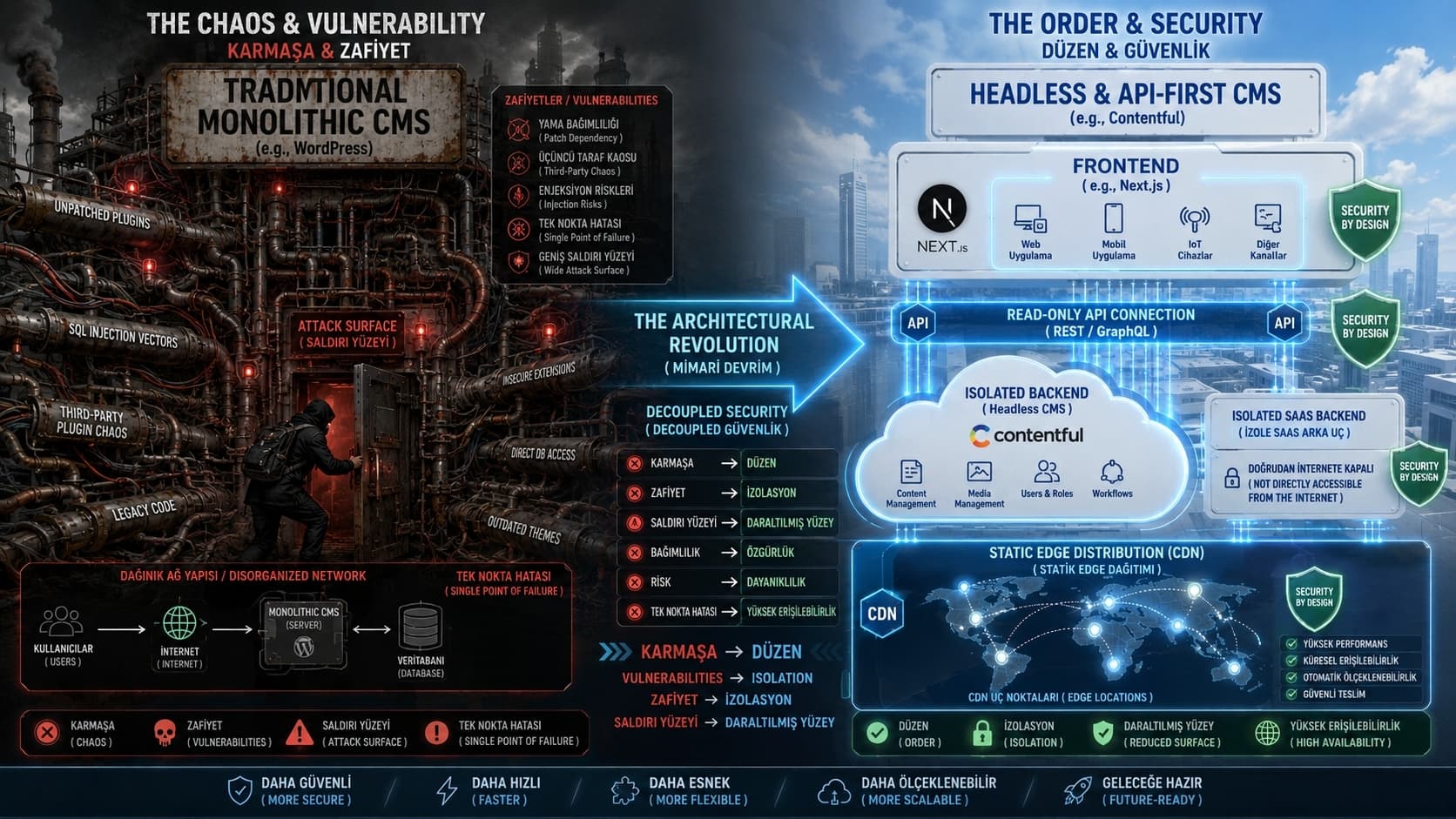
To ensure institutional data integrity and protect brand reputation, replacing traditional monolithic CMS architectures (such as WordPress) with "Headless" and "API-First" architectures is no longer a luxury but a critical strategic mandate against evolving cyber threats.
In the modern global economy where digital transformation has gained momentum, the integrity and security of enterprise data are among the most vital factors determining companies' market value, legal status, and market reputation. A massive portion of the internet ecosystem is built on traditional, monolithic Content Management Systems (CMS), whose design architecture and core working principles date back decades. Today, traditional platforms like WordPress and similar ones, which power 41.9% of websites worldwide, have immense dominance in terms of market share, but due to their rigid structures where the content presentation layer (Frontend) and the database and management layer (Backend) are tightly coupled, they create a massive cyber attack surface.
This report deeply analyzes the structural security risks created by monolithic architectures at the enterprise level, and the financial and reputational damages inflicted on corporate brands by SQL injection and third-party plugin vulnerabilities. In light of global data breach statistics and case studies resulting in cyber disasters, this report demonstrates through concrete architectural examples and economic models to what extent Headless and API-First architectures—where the frontend and backend are completely isolated—reduce cybersecurity costs and breach risk rates.
The Dead End of Monolithic Architectures in Enterprise Security
Traditional web architectures rely on a monolithic design where database queries, business logic, and the user interface (HTML/CSS/JavaScript) are processed within a single server environment or a tightly coupled infrastructure. This integrated structure carries the risk of a "single point of failure" in security architecture. Any weak link in the system can lead to the entire server, file system, and critical database being compromised in seconds. In the working logic of traditional systems, an external HTTP request directly triggers the application's core code, and this code sends direct queries to the database located on the same local network (or the same machine) to retrieve the necessary data. This direct contact is the most critical bridge allowing cyber attackers to infiltrate the internal network from the external network.
The Chaos Created by the Third-Party Plugin Ecosystem and Vulnerability Anatomy
The largest and most uncontrollable source of vulnerability in monolithic systems is the third-party plugin and theme ecosystems installed to add functionality to the system. When examining the market-leading WordPress ecosystem, the severity of this situation is clearly seen. There are over 73,937 vulnerabilities recorded by the WPScan cybersecurity database. When the source of this vast vulnerability pool is analyzed, it has been determined that 93% of the issues originate directly from third-party plugins, 7% from themes, and only 1% from the platform's core software. There are more than 15,666 vulnerable and attack-prone plugins known to be actively used in systems.
An enterprise-level monolithic web installation typically hosts dozens of different plugins for search engine optimization (SEO), firewalls, caching, contact form management, and customer relationship integrations. Due to the nature of monolithic architecture, each installed plugin executes its own database queries and generally operates at the same high privilege level as the system core. This situation paves the way for a minor input validation error made by an independent plugin developer anywhere in the world to provide direct unauthorized access to a massive enterprise database.
According to Patchstack security database analyses, the types of security vulnerabilities in these software and their impacts on the system follow specific patterns:
Vulnerability Type | Frequency | Impact Area and Cybersecurity Consequence |
Cross-Site Scripting (XSS) | 41.46% | Theft of user sessions, browser-based malicious code execution, fake content injection. |
Various Logic Flaws | 17.93% | Flaws in application logic, configuration deficiencies, and business logic bypasses. |
Cross-Site Request Forgery (CSRF) | 13.56% | Forcing critical actions in the system without the consent or knowledge of authorized users (administrators). |
Broken Access Control | 12.88% | Access to administration panels and confidential data by unauthorized persons or low-privileged profiles. |
SQL Injection (SQLi) | 6.28% | Complete reading of the database, modification of customer records, or total deletion of tables. |
Sensitive Data Exposure | 5.23% | Exfiltration of database passwords, API keys, or customer PII (Personally Identifiable Information) data. |
Looking at the patch priority status of the detected vulnerabilities, 64% of the security flaws are in the low, 20% in the medium, and 16% in the high priority category requiring immediate intervention. According to CVSS (Common Vulnerability Scoring System) severity levels, 32% of the vulnerabilities are high (7.0-8.9), and 7% are at a critical level (9.0-10.0) that could crash the entire system in seconds. The presence of these vulnerabilities in the corporate network lays the groundwork for cyber attackers to make lateral movements from the outside in. In particular, vulnerabilities like XSS and SQL Injection make it possible to descend into the core of the enterprise data warehouse through a poorly coded contact form, a visual slider, or a newsletter plugin.
The Financial and Reputational Destruction of Traditional System Vulnerabilities
The cost of structural weaknesses and the plugin soup in monolithic systems to businesses is not limited to just a few hours of technical downtime. Such vulnerabilities turn into massive financial disasters that can lead to forensic processes lasting months, fines imposed by regulatory bodies, massive customer losses, and the complete destruction of the corporate brand.
Financial Analysis of Global Data Breach Costs
The cost of a broad cyber threat landscape to enterprises is very clearly measured in the "Cost of a Data Breach" reports prepared by the independent Ponemon Institute for IBM, which examined over 600 organizations in 16 different geographies and 17 sectors. According to 2025 data, the global average cost of a data breach is calculated at 4.44 million USD. Although this figure has retreated by 9% from its peak of 4.88 million dollars in 2024 with the introduction of AI-supported defense systems, the volume of cybercrime is rapidly increasing.
When the distribution of costs is analyzed regionally and sectorally, the dimensions of corporate destruction become dramatic. In the United States, the average cost of a data breach has soared past the 10 million dollar mark for the first time in history, reaching 10.22 million dollars due to strict legal regulations (GDPR-like state laws, SEC disclosure rules), class action lawsuits, and high breach notification costs.
Evaluated on a sectoral basis, the weakness of the security architecture is much more costly:
Industry / Sector | Average Breach Cost (2025) | Contributing Factors |
Healthcare | $7.42 Million | Highest cost for 14 consecutive years. HIPAA compliance penalties, medical device vulnerabilities, and the black market value of PHI (Protected Health Information). |
Financial Services | $5.56 Million | Heavy regulatory fines, fraud liabilities, and sophisticated nation-state attacks. |
Industrial Manufacturing | $5.00 Million | Supply chain risks, OT (Operational Technology) disruptions, and ransomware operations. |
There are four main expense items that make up these astronomical costs. The first item, "Detection and Escalation", takes the largest share with an average amount of 1.47 million dollars. In monolithic systems, threat hunting and forensics processes operate extremely slowly because the system itself contains a lot of code clutter. The second largest item is "Lost Business" with an average of 1.38 million dollars; this figure directly covers operational downtime, lost revenues, and customer churn due to a loss of trust in the brand. Post-breach response and legal expenses (fines, settlements, legal fees) amount to 1.20 million dollars, while finally, the costs of notifying customers and regulators reach an average of $390,000.
Additionally, a new dimension of corporate vulnerabilities, "Shadow AI", meaning the uncontrolled integration of unauthorized generative AI tools without access controls into corporate systems, adds a single burden of $670,000 to the cost of a standard data breach. It has been found that 97% of these AI-based breaches are directly caused by inadequate access controls.
For corporate security leaders, the truly remarkable data is how specific security strategies increase or decrease these costs:
Cost Amplifiers | Impact Amount | Cost Mitigators | Impact Amount |
Supply Chain Breaches | + $227,244 | DevSecOps Architecture | - $227,192 |
Security System Complexity | + $207,914 | AI/ML Insights | - $223,503 |
Shadow AI | + $200,321 | Security Analytics / SIEM Use | - $212,061 |
Security Skills Shortage | + $173,400 | Strong Encryption Systems | - $208,087 |
Compliance Failures | + $173,692 | Proactive Threat Intelligence | - $211,906 |
Note: The data in the table is compiled from IBM 2024-2025 reports.
A Case of Monolithic Collapse: The Panama Papers
The most striking historical example showing that cyber vulnerabilities can result not only in financial loss but in the complete erasure of an institution from the face of the earth and the outbreak of international political crises is the "Panama Papers" leak. In this incident, the largest data leak to journalists in history, a total of 11.5 million documents and 4.8 million emails amounting to 2.6 terabytes were exfiltrated from the systems of the Panamanian offshore law firm Mossack Fonseca.
While the public thought an attack of this magnitude was carried out by a highly complex and state-sponsored cyber army (APT - Advanced Persistent Threat), forensic investigations by security experts revealed that the leak stemmed from extremely simple and familiar monolithic CMS vulnerabilities. The vastness of the cyber threat landscape caused the firm to collapse from within.
When the anatomy of the attack is examined, three main monolithic vulnerabilities stand out:
WordPress and Revolution Slider Vulnerability: Mossack Fonseca's corporate website was running on a WordPress architecture. An old and unpatched version of a popular plugin called "Revolution Slider" was being used to create a visual slider on the site. This plugin contained a critical security flaw in its file upload mechanisms. The attackers executed an extremely simple exploit code to upload a backdoor (webshell) to the corporate web server. Once access to the server was gained, the
wp-config.phpfile, where database passwords were stored in plaintext, was easily read, and the entire web database was compromised.Lateral Movement and Email Breach: One of the biggest problems in traditional systems is the lack of server isolation. The firm was using the "WP SMTP" plugin on WordPress to send emails to customers via the website. This plugin stored the credentials and server address of the institution's main email server in plaintext within the database. Moreover, the firm's web server and the massive email server hosting 4.8 million confidential correspondences were located on the same network segment. The attacker, having compromised the web server, easily jumped to the email server using the obtained SMTP passwords.
Drupal 7.23 and the SQL Injection Disaster: The subdomain named "Mossfon Client Information Portal", where the firm hosted clients' confidential files and logins, was using an archaic Drupal 7.23 version that had not been updated since 2013. This version contained exactly 23 known security vulnerabilities. The most critical one was a massive SQL Injection vulnerability announced to the world in October 2014. Using the SQL vulnerability in this unpatched monolithic system, attackers queried and exported all encrypted documents, stocks, and confidential records in the database.
The cost of this incredible chain of negligence was heavy; Mossack Fonseca, one of the world's largest law firms, lost its reputation and went bankrupt, leaders in many countries, including the Prime Minister of Iceland, resigned, and hundreds of billions of dollars in tax evasion investigations were launched. Very clearly, failing to update the plugins of a monolithic CMS and the lack of isolation between server layers (lack of decoupling) prepared the absolute end of an institution.
The Architectural Revolution: The Security Paradigm of Headless and API-First Systems
Cases like the Panama Papers and data breaches costing millions of dollars have forced modern enterprises to adopt "Secure by Default" and "Security by Design" approaches. At the center of this transformation are Headless and API-First architectures, which structurally eliminate all the vulnerabilities of the monolithic structure.
What is Headless CMS and Why is it Structurally More Secure?
Headless CMS is a modern architecture that completely separates content management, the data warehouse, and the backend logic from the content presentation layer (Frontend) seen by the user. In traditional systems, when a user visits a website, the server compiles PHP (or similar) codes on the same machine, opens a connection to the database, executes SQL queries, generates HTML templates with the returned data, and sends it to the visitor. In this monolithic cycle, there is a potentially breachable direct communication corridor between any user's browser on the internet and the institution's most confidential database.
In Headless architectures, however, this dangerous bond is completely severed and decoupled.
Invisible Backend: Headless CMSs (e.g., Contentful, Contentstack, Storyblok, Kontent.ai) are not located on the public web network. Contents and the database are hosted as SaaS (Software as a Service) on highly secure, closed cloud servers. There is no IP address or open port through which attackers can directly access the administration panel or database over the internet.
Read-Only API Communication: The Frontend is generally built with modern JavaScript libraries like React, Next.js, Vue, or Astro. This frontend communicates with the backend CMS exclusively via RESTful API or GraphQL protocols. Contents are presented as "read-only" when transferred to the frontend. Therefore, even if an attacker attempts an SQL injection (
' OR 1=1 --) in a search box or contact form on the frontend, there is no active database connection in the system to directly receive and process this SQL command. Commands are merely caught at the API gateway and rejected as meaningless text.Static Generation and Edge Computing (JAMstack): In modern architectures, web pages are compiled and turned into static files (HTML, CSS, JSON) before the user requests the page. These files are placed at the edge nodes of global Content Delivery Networks (CDN) like Fastly, Akamai, or Cloudflare. The attacker actually interacts not with a real server, but only with cached static files distributed around the world. It is architecturally impossible to launch a database attack or execute code (RCE - Remote Code Execution) on a static document because there is no executable server engine behind it.
Attack Surface Reduction
The transition from monolithic architectures to API-First structures is the technological pinnacle of the "attack surface reduction" principle in cybersecurity terminology. When the frontend is completely isolated from the backend, the risk profile exposed to the institution changes radically:
Absolute Resistance to DDoS Attacks: Distributed Denial of Service (DDoS) attacks aim to overwhelm servers with fake traffic to take them offline. Because Headless systems handle requests at CDN edge nodes instead of the server, millions of requests are instantly absorbed. Since there is no dynamic page generation load, the server processor or memory does not bloat, and the corporate website remains online under all conditions.
Elimination of Vulnerable Plugins: Traditional CMSs delegate any function they cannot perform (forms, SEO, payment, security) to third-party plugins and grant them root access. Headless architectures, on the other hand, operate on the "Composable" principle. Developers use microservices architecture to bring together independent, specialized, and secure API services for each function (e.g., Stripe API for payment, Algolia API for search). None of these services can access each other's databases. Even if a vulnerability is found in one service, the breach cannot spread laterally to other services.
Protection Against Botnets and Brute Force Attacks: Standard entry points targeted by malicious actors, such as
/wp-adminor/user/login, do not exist in Headless structures. Corporate CMS administration panels are protected behind strict corporate security policies like SSO (Single Sign-On), MFA (Multi-Factor Authentication), and IP restrictions, closed off to the outside world.
Concrete Architectural Comparison of Narrowing the Cyber Threat Landscape
To understand the sharp divide in the cybersecurity dynamics of the two different architectural approaches, it is essential to examine the journey of the same cyber attack across the two different architectures.
Security Metric | Example 1: Monolithic Architecture (e.g., Traditional WordPress/LAMP Stack) | Example 2: API-First and Headless Architecture (e.g., MACH Stack / Next.js + Contentful) |
Architectural Topology | Linux OS, Apache web server, MySQL, and PHP are hosted in the same environment. | The frontend is statically hosted on a Vercel/Fastly CDN. The backend is in an isolated SaaS cloud. |
Attack Vector (Contact Form) | The attacker uploads a PHP web shell to the system via an unpatched plugin (e.g., Contact Form 7). | The attacker tries to upload a malicious file, but the form goes to a serverless function and is only written to an AWS S3 bucket. The file can never be executed. |
SQL Injection (SQLi) | The attacker types | The input hits the strict typing of the GraphQL schema at the API Gateway. Since it is outside the expected data type (string), the API request is instantly rejected. |
Admin Panel Access | The attacker brute forces the | The admin panel does not exist on the public website. It can only be accessed via |
Attack Outcome and Cost | The entire server, database, and customer records are compromised. The institution faces an average breach cost of 4.44 million dollars. | The attack is completely absorbed at the static CDN layer or API Gateway. Not the slightest contact with the database occurs. Breach and data loss are zero. |
This comparison clearly shows that ensuring security in a monolithic structure depends on a flawless development team never making mistakes and plugin developers writing zero-vulnerability code (which is impossible); whereas in Headless architecture, security naturally emerges from the physical isolation of the architecture itself.
Reduction of Security Costs, Operational Load, and Risk Rates
When evaluating investments, corporate technology and security leaders (CIOs/CISOs) look not only at installation costs but also at the "Return on Security Investment" (ROI) and "Total Cost of Ownership" (TCO) metrics. Although the initial setup of a basic corporate monolithic site may seem to be between $10,000 and $25,000, this figure rises above $100,000 for e-commerce and enterprise solutions as the scale grows. However, the real problem is the massive maintenance and security effort that begins after setup.
Transitioning to a Headless CMS architecture is a serious engineering project that generally requires a budget of $30,000 to $100,000 and above on an enterprise scale. Yet, thanks to the operational efficiency it creates in the long run, the elimination of server costs, and the dramatically falling risk costs, this architectural structure quickly amortizes its own investment cost.
The Collapse in SOC (Security Operations Center) and Operational Costs
Keeping traditional web platforms alive against external threats requires complex Web Application Firewall (WAF) management, relentless vulnerability scanning (malware scanning), weekly plugin updates, and emergency patching. The annual cost of enterprise security packages, DDoS protection, and high-availability servers exceeds 15-20% of the initial setup fee, reaching tens of thousands of dollars. Furthermore, continuously updating WAF rule sets and having SOC engineers investigate false positive alerts is a massive drain on human resources.
In headless architecture, data and application security fall on the shoulders of global companies providing the SaaS service under the "Shared Responsibility Model". Leading Headless providers (e.g., Contentstack, Storyblok, Kontent.ai, dotCMS) offer AWS Shield, GuardDuty, high-capacity global CDNs, and advanced WAF solutions integrated into their core platforms in the background. This enterprise-grade isolation eliminates the necessity for institutions to house a massive cybersecurity monitoring team internally. According to the analyses reflected in the report, institutions that have a strong DevSecOps culture and secure their technology stack at the API level save up to 2.2 million dollars in potential security incidents, while the reduction in SOC dependency allows for hundreds of thousands of dollars to be cut from annual operational costs.
Forrester TEI Report and Sectoral ROI Analysis
The abstract security gains of the headless transition have been transformed into concrete economic metrics by independent research organizations. In a high-security sector like financial services, a "Total Economic Impact" (TEI) study conducted by Forrester regarding the use of Kontent.ai (Headless CMS) by a composite enterprise organization revealed striking results: Companies achieved a 320% ROI (Return on Investment) over a 3-year projection.
In an industry survey conducted by Storyblok in 2024 with over 1,700 technology leaders (State of CMS 2024), it was highlighted that 99% of companies transitioning from traditional systems to Headless architecture reported operational improvement, while 61% experienced a direct ROI increase. The main source of these savings is that development teams (IT Overhead) are freed from the drudgery of continuous maintenance and resolving plugin conflicts, allowing them to focus directly on business logic and developing new channels.
Overcoming the Enterprise Compliance Dead End
In heavily regulated sectors such as finance, insurance, and healthcare, it is a legal requirement that the publishing processes of digital content have a complete audit trail and Role-Based Access Control (RBAC). According to IBM data, compliance failures alone increase the cost of a breach by $173,692. Attempting to enforce these controls via plugins in monolithic systems further amplifies legal risk due to the vulnerabilities inherent within the plugins themselves (e.g., privilege escalation by users through broken access control vulnerabilities).
Enterprise Headless platforms offer cloud architectures possessing the world's strictest security certifications, such as ISO 27001, SOC 2 Type II, GDPR, and the automotive industry standard TISAX. These platforms handle Granular Role-Based Access, Single Sign-On (SSO / SAML integration), and authentication systems at the core of the platform. All API interactions, permission changes, and content updates are cryptographically recorded. The exhaustive audit logs demanded by regulatory bodies can be provided instantly without the need for additional development.
Case Studies in Headless Transformation
The theoretical economic and security gains are proven by the actual transformation stories of globally operating enterprises:
Elastic's Giant Transformation: Struggling with the clumsiness and security risks of its traditional system, software giant Elastic migrated its infrastructure from WordPress to the Contentstack Headless CMS. As a result of the project, the company minimized its dependency on external agencies and developers, reducing general business expenses by 78% and server hosting costs by 87%. Thanks to the acceleration and isolation of the architecture, page view rates doubled, and the transformation was completed in a short period of 3 months.
USA Track & Field (USATF) - Isolated Media Security: The United States of America Track and Field Federation had to set up secure and uninterrupted digital rooms for media members during the Olympic trials. Foreseeing that a traditional CMS would fall short, they switched to the Kentico Kontent (Headless CMS) architecture. Thanks to this architectural decoupling, unauthorized access was prevented, the server load was incredibly lightened, and cybersecurity was fully optimized during high-traffic events.
Weaveworks Speed and Security Scaling: Having used WordPress for years, Weaveworks transitioned to Contentstack to catch up with start-up speed, tighten access controls, and ensure cybersecurity. As a result, they achieved a 75% increase in publishing speeds while reaching a much more secure and auditable content delivery strategy.
Artificial Intelligence (AI) and "Composable" Structures in Future Security Strategies
The cybersecurity ecosystem is not static, and data from 2025-2026 show that one of the biggest new corporate threats is the manipulation of "Artificial Intelligence" integrations. It has been determined that 16% of cyber attacks in phishing and vulnerability exploitation are driven by AI. Even more dangerous is the phenomenon of "Shadow AI," where company employees integrate unauthorized Generative AI tools into systems to increase productivity. AI plugins installed into traditional systems without supervision bring the risk of leaking PII, financial data, and intellectual property to 3rd party models, which aggressively drives up data breach costs.
Headless and "Composable" architectures offer a unique advantage to manage this new frontier. These structures allow enterprises to isolate external APIs via an API Gateway with a "Zero Trust" philosophy. Leading Headless CMS platforms (e.g., Kontent.ai's Agentic CMS model) mandate "Human-in-the-loop" and "Permission-bound execution" principles when integrating AI into content operations.
In this architecture, when an AI assistant suggests content creation or optimization, it cannot autonomously log this action into the system by exceeding authority limits. Every action is subjected to existing user permissions, traceable and reversible log records are created, and it is absolutely not reflected in the public domain without passing the approval of a human administrator. This corporate governance layer cuts off unauthorized data manipulation and cyber leaks while taking advantage of the speed of AI.
Conclusion and Strategic Action Plan
In the digital age, the cost of data breaches to organizations has reached 4.44 million dollars globally and critical levels like 10.22 million dollars in strict markets like America. The biggest underlying factor behind these cyber disasters, which can wipe out corporate brands overnight, create legal crises, and cause massive market losses, is monolithic content management systems built with the single-server development paradigms of decades ago, uncontrollably dependent on third-party plugins, and completely devoid of architectural isolation.
Although traditional systems like WordPress, Drupal, and similar ones may seem affordable in terms of initial investment cost and easy to install, the fact that the presentation layer and the core database and business logic (PHP) reside in the same physical or virtual space presents a massive threat landscape to cyber attackers. A single poorly coded visual plugin is enough to leak the entire corporate data warehouse.
For modern enterprises, CIOs, and CISOs, the strategic security vision is quite clear: It is not sustainable to ensure cybersecurity merely through patches subsequently added to the network layer, WAF rules, and anti-virus software. Security must start from the very fundamental architectural code (design) of the system.
In this context, the technological steps to be taken are:
Definitive Transition to Headless Architectures: Especially firms in heavily regulated sectors like finance, healthcare, technology, manufacturing, and e-commerce should position the transition to Headless CMS and API-First architectures—which completely separate the content database from the frontend—not as a marketing or IT luxury, but as a critical "Enterprise Risk Management" strategy.
Making the Attack Surface Static: All dynamic processing ports of web servers (Apache, Nginx, PHP-based) facing the public internet must be closed, and users should only be served pre-compiled static files via Edge Computing technologies (Vercel, Fastly, Cloudflare).
Optimization of WAF and API Security Policies: The SOC engineering effort and financial budgets spent on patching countless vulnerabilities of traditional systems and dealing with false-positive alarms should be redirected to writing API Gateway security policies that protect far fewer endpoints and to applying Zero Trust principles.
Abandoning Third-Party Plugin Dependency: Web functionality must be removed from the plugin logic that grants root access to the core system. "Composable" infrastructures, where independently tested, reputable micro-service providers communicate solely via APIs, must become the standard for corporate security.
Consequently, the presence and integrity of corporate brands in the digital world will be determined by the strategic choice between entrusting the fate of their data to the code quality of hundreds of unnamed third-party developers—deceived by the conveniences offered in the early days of technology—and taking control to choose the structural armor of modern architecture that provides absolute isolation. Decoupled Headless architecture is unarguably the strongest, most scalable, and most secure representative of this armor in today's technological universe.