Migrating from Monolithic Structures to Headless CMS Architecture
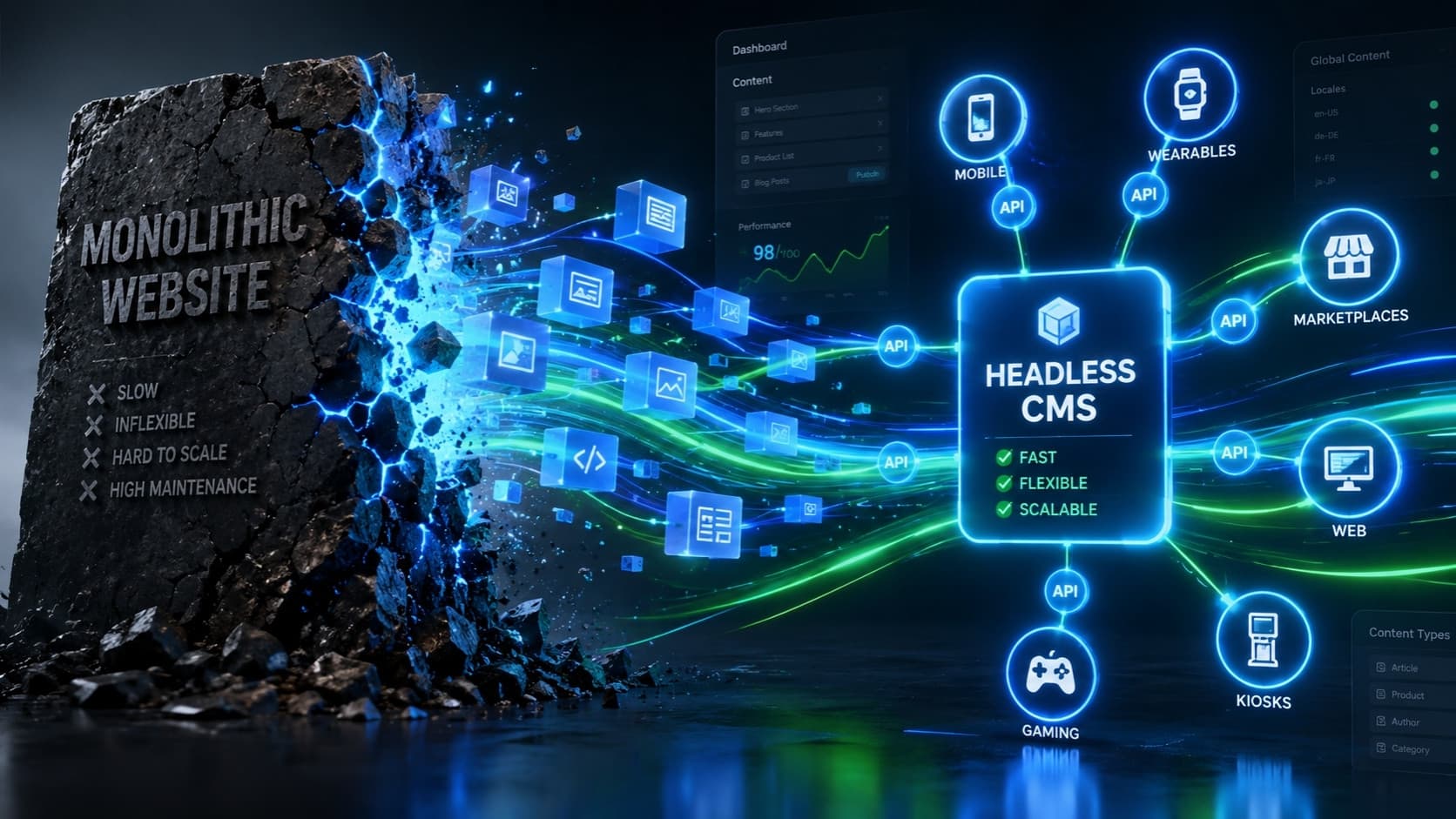
A Performance, Security, and SEO-Oriented Turning Point in Enterprise Digital Transformation
Structural Boundaries of Traditional Monolithic Systems and the Headless CMS Revolution
Traditional content management systems (CMS) laid the foundation for enterprise web presence during the early days of the internet by combining content creation, database management, and visual presentation under a single monolithic roof. WordPress, in particular, has become the most common example of this monolithic approach, dominating more than 41.5% of all websites today and 61.7% of sites using a content management system. However, in monolithic structures, the content repository (back-end) and the presentation layer (front-end) are tightly coupled. This situation forces the server to run database queries, process templates, and compile HTML output in real time for every single page request.
With the rise of the omnichannel digital ecosystem, a need has emerged to publish enterprise content simultaneously not only on standard browser-based web pages, but also on mobile applications, smart devices, IoT screens, e-commerce portals, and smart displays. Monolithic systems fall short in responding to this omnichannel structure, forcing businesses to manage a separate CMS instance for each channel or to use complex integration patches.
Headless CMS architecture represents a paradigm that completely decouples the back-end from the front-end to eliminate these limitations. In this modern approach, content is stored as "structured data" independent of the presentation format and is distributed to consumer applications via RESTful or GraphQL APIs. While developers are given the freedom to use their preferred modern front-end technologies, marketing teams can manage content from a single central hub under the "Create Once, Publish Everywhere" (COPE) principle. This transformation has gained momentum in the corporate world, with 73% of companies positioning headless architectures at the center of their digital strategies.
Architectural Criterion | Traditional Monolithic CMS (e.g., WordPress, Drupal) | Modern Headless CMS (e.g., Sanity, Contentful, Storyblok) |
Front-End and Back-End Relationship | Tightly coupled (Coupled) | Completely decoupled (Decoupled/API-driven) |
Content Delivery Capability | Limited to web templates only | Web, mobile, IoT, smart devices, and AI channels |
Scalability and Traffic | Dependent on database and server hardware limits | Automatically scalable with global CDN integration |
Developer Independence | Platform-specific coding languages (e.g., PHP, template engines) | Support for preferred language and modern JavaScript frameworks (Next.js, etc.) |
Enterprise Security | Risky due to plugins and shared server boundaries | Isolated data repository and read-only API gateways |
The Performance and Security Dilemma of Traditional Bloated Architectures
As monolithic systems grow and functionality demands increase, they inevitably encounter "bloated system" problems. Platforms like WordPress depend on external plugins for core enterprise needs such as form management, SEO optimization, and e-commerce integration. These layers of plugins, accumulating over time, bloat the database, strain PHP memory limits, and severely delay server response times (TTFB). Heavy code libraries sabotage the page experience directly by causing unnecessary CSS and JavaScript files to be loaded into the browser.
This decline in performance translates directly into commercial losses. According to 2025 data, only 47% of global websites meet Google's Core Web Vitals performance thresholds. Slow-loading digital experiences increase bounce rates on enterprise platforms, leading to revenue losses ranging from 8% to 35% in organic rankings and conversions.
On the security front, monolithic architectures possess a wide attack surface. Because the administration panel, database access, and web presentation run on the same server, a security vulnerability occurring on the front-end (for instance, an SQL Injection) can lead directly to the compromise of the corporate database. The fact that approximately 97% of new vulnerabilities detected in WordPress sites in 2023 originated directly from plugins clearly demonstrates the scale of this risk. Furthermore, the fact that nearly 30% of the most critical WordPress plugins do not receive any security patches condemns businesses to a continuous cycle of patch management and cyber threats.
The Limitations of Unstructured Content in the Age of AI and Large Language Models (LLM)
One of the most critical modern threats faced by traditional monolithic systems is the way artificial intelligence search engines and large language models (LLMs) crawl the internet. Traditional CMS structures store content devoid of semantic relationships, embedded solely within specific "page templates" and HTML codes. AI systems and smart search agents, on the other hand, require clean, structured data to make sense of information, trigger automated workflows, and generate personalized responses.
Monolithic content mixed with the presentation layer (HTML/CSS templates) is difficult for AI models to crawl and is often misinterpreted. This situation reduces brands' chances of being cited as references in generative AI-based search engines (ChatGPT, Perplexity, Claude, etc.). Since Headless CMS stores content entirely as semantic objects in JSON or Markdown format, it offers the most ideal infrastructure that can be directly fed into AI models.
Analysis of Enterprise-Level Security and Infrastructure Risks
Headless architecture establishes an overwhelming superiority over monolithic structures in the security layer. The basis of this superiority lies in completely closing the back-end content repository to public internet access and restricting all connection with the front-end to authenticated API gateways.
[User / Browser] ---> [CDN / StaticFront - End (Next.js)]
|
(OAuth 2.0 / JWT)
v
[API Gateway / WAF]
|
v
[Headless CMS Repository]
This decoupling process radically changes the mechanism of cyberattacks:
Prevention of Write-Based Vulnerabilities: The fact that content delivery APIs offer only "read-only" access largely eliminates SQL injection and Cross-Site Scripting (XSS) attacks executed through web forms.
Resilience Against DDoS and Traffic Intensity: In 2024, more than 311 billion web application and API attacks occurred globally, and Layer 7 (L7) DDoS attacks increased by 94% over the last two years. While it is inevitable for a monolithic site to experience database locks under this traffic and request load, headless systems can handle millions of requests within seconds at the CDN level because the front-end consists of static files, minimizing resource consumption.
NoSQL Injection and SSRF Threats: API-based systems also have their own specific risks (OWASP API Security Top 10). However, modern headless CMS structures proactively eliminate these risks by being equipped with static code analysis and dynamic NoSQL injection detection algorithms (e.g., schema validation services).
Next.js and Headless CMS Synergy: Enterprise Website Acceleration and Core Web Vitals Optimization
Next.js has become the default standard for headless CMS integrations in the modern web world. This powerful React-based framework maximizes the performance of enterprise websites through the hybrid rendering strategies it offers:
Static Site Generation (SSG): This is the process where content is fetched at build time, transformed into static HTML pages, and served directly over a global CDN. This method reduces server response time (TTFB) to milliseconds.
Incremental Static Regeneration (ISR): While ensuring that pages are served at absolute static speed, it allows pages to be dynamically updated in the background at specific time intervals or when CMS webhooks are triggered. In this way, content remains fresh at all times without rebuilding the entire site.
Server-Side Rendering (SSR): This is the strategy where a page request is processed on the server side within milliseconds and ready HTML is sent to the browser, especially for dynamic pages like personalized user data or instantly changing pricing.
The Core Web Vitals metrics used by Google to determine page experience, and consequently organic search rankings, can be made flawless with the duo of Next.js and headless CMS.
Largest Contentful Paint (LCP) Optimization
LCP measures the time it takes for the largest image or text block that forms the main focus of the page content to appear on the screen, and this duration must be under 2.5 seconds. Next.js automatically scales images according to the browser size with the next/image component and serves them in modern compression formats such as AVIF/WebP.
For hero images located in the visible area at page load (above-the-fold), it must be made mandatory to download these resources before all other style and JavaScript files by using priority or preload attributes. This optimization minimizes bounce rates by reducing LCP values from red thresholds like 3.5 seconds to competitive levels like 1.2 seconds.
Interaction to Next Paint (INP) Optimization
Measuring the response time given by the browser when users click a button or a menu on the page, INP became an official Core Web Vitals metric as of March 2024 and must remain below 200 milliseconds. Heavy JavaScript execution times that block the main thread in traditional WordPress sites damage the INP score.
Next.js radically reduces the JavaScript size going to the client with its React Server Components (RSC) architecture and resolves most of the page logic on the server. Furthermore, heavy external libraries that need to be loaded dynamically (e.g., analytical tools, advertisement codes) are deferred using the next/script component and the lazyOnload loading strategy; thus, the browser's main thread is liberated to respond to interactions at any moment.
Cumulative Layout Shift (CLS) Optimization
It is desired that the CLS value, which measures visual stability and checks whether elements shift unexpectedly while the page is loading, be below 0.1. Next.js ensures that the browser reserves space for the relevant media prior to loading (layout reservation) by mandating width-height values for images and videos.
The next/font component is used to prevent visual jumps (FOIT/FOUT) experienced during the loading of fonts. This component automatically downloads fonts to the local server and embeds them into the CSS. Pre-reserved container spaces must also be defined using CSS Grid or Flexbox for dynamic content areas (ads, notification bars).
Core Web Vitals Metric | Ideal Target | Common Issues (Monolithic Infrastructure) | Next.js Integration Solutions |
LCP (Largest Contentful Paint) | < 2.5 seconds | Unoptimized images, heavy server responses, render-blocking resources. | Use of |
INP (Interaction to Next Paint) | < 200 milliseconds | Excessive plugin usage, long-running JavaScript tasks, main thread blockage. | Code reduction with React Server Components (RSC), deferred loading with |
CLS (Cumulative Layout Shift) | < 0.1 | Unsized media elements, late-loaded fonts, dynamic ad spaces. | Font inlining with |
Analytical Evaluation of Enterprise-Level Headless CMS Options
There are various headless CMS platforms that businesses can prefer according to their needs and organizational structures. The architectural flexibility, editor experience, and technical integration capacity offered by each platform differ.
Sanity
Treating content entirely as "structured data," Sanity offers developers unlimited data modeling flexibility with GROQ and GraphQL query languages. Its customizable administration panel (Sanity Studio), which offers real-time collaboration opportunities, is ideal for large-scale and multi-author teams.
Storyblok
This platform resolves the lack of visual previewing—the biggest complaint of marketing teams—with the integrated visual editor it offers. Thanks to its component-based approach, marketers can construct new pages using the drag-and-drop method without being dependent on the software team. It offers an advanced and native integration with the Next.js App Router.
Contentful
This is a cloud-native digital experience platform (DXP) designed to manage multi-brand, multi-lingual, and global-scale enterprise operations. It fully meets enterprise scalability requirements thanks to its AI-based content generation tools, automated translation workflows, and wide integration marketplace.
Strapi
Thanks to its open-source nature, it is a platform that can be completely self-hosted on an enterprise's own servers and deeply customized according to data privacy standards. It offers both an independent and cloud-based hybrid development ecosystem with its active community support and Strapi Cloud option.
Payload CMS
This is an innovative, TypeScript-based, open-source CMS solution that can run directly within the codebase of Next.js applications (monorepo/shared codebase). It eliminates the requirement to host an extra server or an independent administration panel, providing the developer with full code ownership and the advantage of zero vendor lock-in.
Prismic
This is a platform possessing a "Slice" architecture that aims to reduce developer intervention to zero on small and medium-sized marketing sites. Thanks to pre-defined page sections, content creators can quickly create visual variations.
Platform | Best-Fit Scenario | Core Technical Strength | Integrated Advanced Features | Hosting Model |
Sanity | Complex data relationships and omnichannel management. | GROQ & GraphQL flexibility, real-time data streaming. | Real-time collaborative studio. | Cloud (SaaS) / Customizable Front-End. |
Storyblok | Marketing teams producing intensive content and wanting visual independence. | Visual page builder (WYSIWYG visual editor). | Component-based design language integration. | Cloud (SaaS). |
Contentful | Global, multi-lingual, and multi-brand corporate structures. | Powerful enterprise APIs, high SLA assurances. | AI translation and advanced personalization tools. | Cloud (SaaS). |
Strapi | Projects with data sovereignty and high customization needs. | Customizable admin panel, role authorizations. | Wide community plugin library. | Self-Hosted / Strapi Cloud. |
Payload CMS | 100% integrated with Next.js, single codebase TypeScript projects. | Embedded operation within Next.js, native TS support. | Schema management directly at code level. | Self-Hosted / Shared Infrastructure. |
Commercial Performance and Conversion Rate Correlation: Real Success Stories
Speed is the most decisive factor of modern user experience and, consequently, digital sales. Every 3-second improvement achieved in page load times provides measurable increases in conversion rates by dropping bounce rates directly. Real data from brands migrating from traditional systems to headless infrastructures clearly proves this performance-revenue relationship.
Case Study 1: Ultimate Finance (Transition from Monolithic to Gatsby/Headless Architecture)
Experiencing disruptions in user experience due to the speed boundaries and plugin clutter brought by a traditional WordPress installation, the financial institution Ultimate Finance moved its infrastructure to a decoupled design. The existing WordPress infrastructure was preserved as the content management panel, but the front-end was completely rebuilt with a modern and fast static site generator via WPGraphQL. The speed of the site was pulled from traditional 2-second limits down to the 200-millisecond levels.
Following this transformation, while remarkable increases were experienced in desktop and mobile traffic rates, the main commercial leap took place in the conversion funnel: the rate of users who started filling out the quote form and completed the process (Conversion Rate) rose from 0.8% to 1.5%, showing a net increase of 87%. The rate of form submissions reaching the final step went from 8.9% to 16.4%, providing an 84% efficiency increase.
Case Study 2: Leading Global Jewelry Brand (DLS and Scalability Transformation)
Moving its monolithic infrastructure to a multi-lingual, multi-regional, and centralized headless CMS platform in line with its growth targets, the luxury consumer brand followed a two-year phased migration process.
The Design Language System (DLS) developed within the scope of the process ensured that more than 2000 pages located across 3 different websites of the brand were presented with the same visual language and mobile-first user experience. The web traffic of the brand reaches its peak especially during intense campaign periods between October and December. Thanks to the high flexibility and performance offered by the headless architecture, the system met the excessive traffic load during these periods with zero downtime, carried e-commerce conversions upward, and seriously lowered operational costs.
Case Study 3: Leesa Sleep (Organic Traffic and Operational Efficiency)
Wanting to increase e-commerce conversion rates and overcome technical bottlenecks in content updating processes, the sleep products brand Leesa Sleep migrated to Contentstack’s enterprise headless CMS solution. This transition enabled marketing teams to create instant campaigns without being dependent on developers, increased content production speed, and directly provided an increase in organic traffic and e-commerce revenues by raising the site's visibility in organic search results.
Integration Clutter and Hidden Cost Warnings
Although the headless CMS migration offers great opportunities for businesses, it can also bring along some challenges ignored during the planning phase. While everything is resolved in a single database in a monolithic system, each service such as CRM, customer data platforms (CDP), analytical tools, search engines, and payment gateways must be connected via APIs in headless structures.
The increase in these integrations can raise development and maintenance budgets. For this reason, experienced teams should be engaged at an early stage in migration projects, the API architecture must be constructed correctly, and enterprise integration budgets that will replace the simple plugin comfort offered by the monolithic system must be planned realistically.
Technical SEO, Generative Search (GEO), and Editorial Workflows Integration
One of the most common misconceptions in migrating to headless architecture is the thought that the absence of ready-made plugins like Yoast or RankMath in monolithic systems will harm SEO performance. In fact, the headless structure allows search engines to crawl and index the site much faster by granting developers full control authority over technical SEO elements.
The technical standards that businesses must implement to optimize SEO, GEO, and content processes are as follows:
Flexible URL and Meta Management Specific to Marketers: It is a fundamental requirement of technical SEO that editors can change URL slugs without leaving the CMS panel, define canonical (original URL) rules specific to pages, and be mandated to enter image alt texts. These fields must be modeled as required fields in the CMS.
Dynamic Metadata Integration with Next.js App Router: Operating on the server side, the
generateMetadatafunction processes SEO data coming from the CMS into the HTML header field before the page is even sent to the browser.
TypeScript
// app/blog/[slug]/page.tsx - Dynamic Metadata Integration
import { Metadata } from 'next'

interface Props {
  params: { slug: string }
}

// Helper function fetching content and SEO data from CMS
async function getPostData(slug: string) {
  const res = await fetch(`https://api.kurumsalcms.com/posts/${slug}`)
  return res.json()
}

export async function generateMetadata({ params }: Props): Promise<Metadata> {
  const post = await getPostData(params.slug)

  if (!post) return {}

  return {
    title: `${post.seoTitle} | Corporate Brand`,
    description: post.metaDescription,
    alternates: {
      canonical: post.canonicalUrl || `https://www.kurumsalsite.com/blog/${params.slug}`,
    },
    openGraph: {
      title: post.seoTitle,
      description: post.metaDescription,
      type: 'article',
      publishedTime: post.publishedAt,
      images: [{ url: post.featuredImageUrl }],
    }
  }
}
Artificial Intelligence and GEO (Generative Engine Optimization) Strategy: While traditional systems design pages only for human users, modern enterprise websites must also be optimized for AI search engines. In this process, the
robots.tsfile of the Next.js project must grant explicit permissions to popular AI crawlers such as GPTBot, Claude-Web, PerplexityBot, and ChatGPT-User. Thus, corporate content is fed into next-generation traffic channels by being shown directly as sources and citations in generative AI queries.Secure Preview Bridge with Next.js Draft Mode: The Next.js Draft Mode feature must be activated so that marketing teams can see draft content live on the site before it is published. In this mechanism, the "Preview" button in the CMS panel calls a secure API route (
/api/draft) on the Next.js side. This API route verifies the secret token coming from the CMS and assigns a temporary preview cookie (__prerender_bypass) to the browser, allowing Next.js to bypass the static cache and show the current draft data directly.
Lossless Migration Methodology from WordPress to Headless Architecture
Moving a monolithic WordPress site to a headless structure is a migration project that must be managed meticulously in order not to experience data loss and organic ranking loss. The technical roadmap that must be followed for a successful replatforming process is detailed below:
1. Auditing the Existing Site and Extracting the Content Map
The first step is to extract a complete inventory of all live URLs, image files, meta descriptions, and taxonomies (category/tag) structures on the existing monolithic site. The entire URL tree of the site should be crawled using Firecrawl or similar advanced web scraping APIs, and the data must be transformed into structured JSON schemas.
2. Data Modeling on the Target Headless CMS
Complex data structures in the old monolithic system (Custom Post Types, ACF fields) must be remodeled as clean and relational schemas (Schemas) on the new headless CMS platform. At this stage, internal links and media references embedded (hardcoded) inside text fields in the old system should be detected and transformed into objects compatible with the new CMS schema.
3. Executing Automated Migration Scenarios and Data Transfer
Moving content manually on large enterprise sites with hundreds or thousands of pages leads to loss of time and errors. For this reason, contents fetched from the old WordPress database via WP-REST-API or WPGraphQL are sent in bulk (batch processing) to the new headless CMS APIs with the help of custom written migration scripts, and the transfer is completed.
4. 301 Redirect Strategy and Preservation of Link Value
The most critical mistake made during migration processes is the breaking of old URL structures in the new system. This situation leads to the total collapse of SEO performance. To prevent this, a comprehensive redirects.json file mapping between old URLs and new Next.js dynamic routes (/blog/[slug]) must be prepared. These redirects must be defined as permanent 301 redirects at the server layer (Next.js middleware or CDN level) and tested one by one in the staging (test) environment with tools like Screaming Frog prior to going live.
JSON
// redirects.json - 301 Permanent Redirect Schema
[
  {
    "source": "/old-category/wordpress-post-name",
    "destination": "/blog/wordpress-post-name",
    "permanent": true
  },
  {
    "source": "/wp-content/uploads/:path*",
    "destination": "https://cdn.kurumsalsite.com/uploads/:path*",
    "permanent": true
  }
]
Conclusion and Strategic Recommendations for Enterprise Decision Makers
The transition from monolithic structures to a modern Next.js-backed Headless CMS architecture is a true turning point that enables enterprise businesses to leap forward in the fields of digital marketing, performance, cybersecurity, and AI compatibility.
It is proven by corporate case studies that speed gains measured in milliseconds directly provide conversion increases of over 80%. The action plan for corporate decision-makers who want to realize this transformation should be as follows:
Liberate Marketing and Engineering Teams: Investment should be made in decoupled architecture so that developers can break free from design template constraints, and marketing teams can publish multi-lingual and omnichannel content without waiting for technical team approval.
Make Core Web Vitals Performance a KPI: The performance of your corporate website is not just a technical indicator, but a business metric providing revenue and visibility directly. Keep LCP and INP values in the green zone by integrating Next.js optimization tools into your processes.
Construct AI and GEO Strategies Starting Today: Equip your website with semantic structured data models that not only search engine bots but also AI agents and large language models can easily read and cite as sources.
Manage the Migration Process as a Professional SEO Project: Implement content auditing, data schema creation, 301 redirect mapping, and pre-live staging test processes with an exhaustive methodology to experience zero organic traffic loss in WordPress-to-headless migrations.