AI Agent vs. Chatbot: Why Companies Are Now Building Systems That Do Work, Not Just Answer Questions
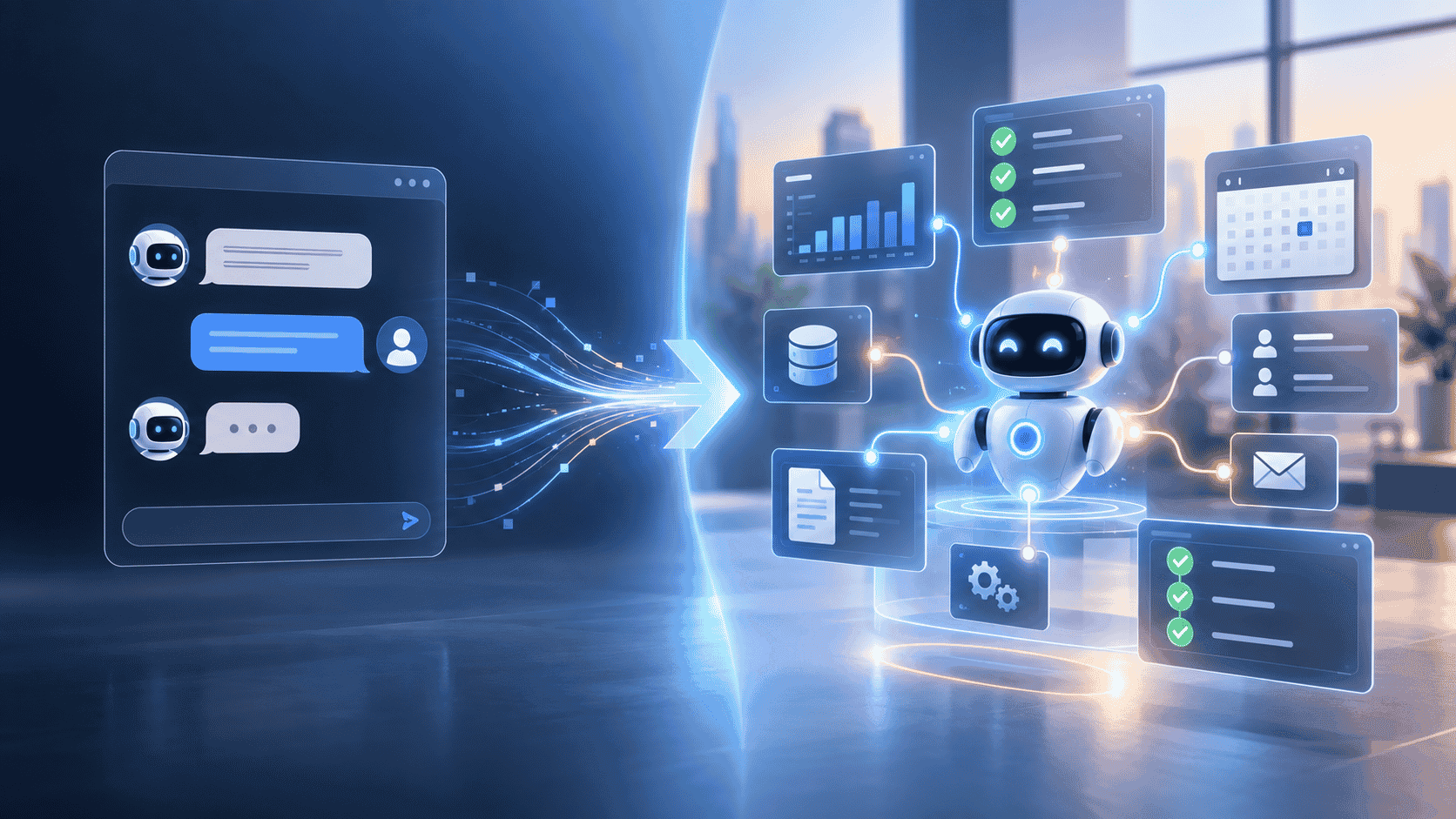
The key transformation in enterprise AI is not simply that models can communicate better, but that they can safely and controllably take action across software systems. The primary output of a traditional chatbot is an answer. The output of an AI agent is completed work: checking an order, creating a return, updating a CRM record, preparing a quotation, reviewing a document, analyzing supplier risk, or initiating a transaction after the required approval. For this reason, chatbots and AI agents are not the same. **A chatbot is often a user interface; an agent is a decision-making, tool-using, and execution architecture.** By working with APIs, enterprise data, memory, workflows, and permission controls, an agent can complete multi-step tasks and request human approval when necessary. Real-world examples demonstrate the operational value of this shift. Klarna reported that its AI assistant handled 2.3 million customer conversations in its first month, reduced resolution time from 11 minutes to under 2 minutes, and cut repeat inquiries by 25%. Eczacıbaşı Holding reported reducing some supplier-risk decision cycles from as long as two weeks to under three days and shortening certain mining analyses by more than 90%. However, agent systems also introduce greater operational risk than chatbots. A wrong answer creates an information-quality problem; a wrong agent action can modify records, trigger financial transactions, or access sensitive data. Identity management, least-privilege permissions, human approval, audit logs, sandboxing, monitoring, and rollback mechanisms therefore become core architectural requirements. For companies, the right objective is not maximum autonomy but measurable and economically optimal autonomy. Success should no longer be judged by how well an AI can talk, but by what work it can reliably complete, at what cost, with what success rate, under what authority, and within which security boundaries.
From Chatbot to AI Agent: Definitions, History, and the Real Difference
The concept of the chatbot is a design pattern that predates modern artificial intelligence. Early systems created the impression of conversation by matching user input against predefined patterns, whereas today’s large language models can generate free-form language, synthesize information, and reason within context.
However, the critical development that enabled the transition to agent architecture was not simply stronger language generation. It was the model’s ability to interact with tools in the outside world in a controlled manner.
This transition became particularly visible in research conducted during 2022–2023. The ReAct approach developed by researchers from Google and Princeton combined reasoning and action in a loop: the model reasons, selects an action, receives an observation from the environment, and updates its plan based on that new observation.
The study demonstrated behaviors that now form the foundation of agent systems, including creating plans for long-running tasks, tracking progress, and modifying plans in response to exceptions.
Toolformer, meanwhile, demonstrated that a language model could learn which API to call and when, which arguments to send, and how to incorporate the returned result into subsequent generation. The research used external tools such as calculators, search, question answering, translation, and calendars.
Today’s production platforms have productized these ideas. In OpenAI’s current agent infrastructure, agent definitions, session/state management, tools, MCP connections, sandboxes, multi-agent orchestration, tracing, and observability are treated as separate components.
Anthropic similarly defines an agent as a system capable of dynamically directing its own processes and tool usage, while recommending workflows for more deterministic tasks.
Chatbots and AI Agents Are Not the Same Thing
Dimension | Traditional / LLM-Based Chatbot | AI Agent |
|---|---|---|
Primary purpose | Understand a question and generate an answer | Achieve a defined outcome |
Success metric | Answer accuracy, relevance, CSAT | Task completion rate, time, errors, cost, business outcome |
Control flow | Usually user → model → answer | Plan → tool → observation → new decision → action loop |
Autonomy | Low | Can range from controlled low autonomy to high autonomy |
Context | Mostly conversation history / RAG | Session, task state, enterprise data, and persistent memory |
Multi-step tasks | Limited or managed through application code | One of its natural use cases |
API usage | May be used to retrieve information | Can retrieve information as well as create or modify records |
Side effects | Usually none | Can send emails, update CRM records, create orders, etc. |
Human approval | Usually not required | A critical control mechanism for risky actions |
Operating mode | Reactive | Can be reactive, event-triggered, or proactive |
Failure risk | Incorrect answer | Incorrect action; therefore operational risk is higher |
For this reason, turning a company’s “chatbot into an agent” is not about slightly improving the prompt. It requires redesigning the permission model, system integrations, observability, and operational ownership.
A Brief Historical Inflection Point
Period | Dominant Paradigm | Enterprise Significance |
|---|---|---|
Early conversational systems | Rule/pattern-based conversation | Demonstrated that human–machine dialogue was possible |
Transformer and large language model era | Natural language generation and context | Enabled free-form enterprise assistants |
RAG era | Retrieval from enterprise data | Bots began answering based on the organization’s own documents |
ReAct / tool-use era | Reasoning + external-world action | The model evolved from a system that merely “knows” into one that can “use tools” |
Agent platforms | State + tool + memory + orchestration + governance | Enabled multi-step business processes to be executed in production |
The strategic distinction here is important: An LLM is an intelligence engine; an agent is an operating system in which that engine is surrounded by goals, memory, tools, permissions, and control mechanisms.
Technical Architecture and Capability Differences
In a simple chatbot architecture, traffic generally flows from the user to the model, from the model to an information source, and then back to the user.
In an agent architecture, however, the central element is no longer just the LLM, but the orchestration layer that manages state and the action loop.
In Anthropic’s “augmented LLM” approach, the model is extended with retrieval, tools, and memory components. In more advanced agent structures, the model can repeatedly direct its actions by receiving feedback from the environment.
Recommended Enterprise Agent Architecture
In this architecture, an “agent” is not a single prompt. There are at least eight distinct areas of responsibility: authentication, orchestration, model execution, state/memory, enterprise information access, the tool/API layer, the security-policy layer, and observability.
OpenAI’s current platform documentation similarly positions sessions, sandboxes, tools, MCP, multi-agent capabilities, permissions, tracing, and observability as separate production components.
Google’s current Agent Platform architecture also provides runtime, sessions, Memory Bank, IAM-based agent identity, tracing, logging, and monitoring as separate services.
Autonomy: Not “How Intelligent?” but “How Much Authority?”
It is more accurate to evaluate the maturity of an agent not by its model score, but by the scope within which it can make decisions and create consequences.
In practice, four levels can be used:
Level | Behavior | Example | Recommended Control |
|---|---|---|---|
Advisor | Only recommends | “Give this customer the following response” | Output validation |
Copilot | Prepares a transaction draft | Return record or quotation draft | Human “approve” button |
Controlled agent | Performs certain actions independently | Automatically completes a low-value refund | Permission limit + audit |
Autonomous process | Executes an objective end to end | Classifies request, investigates, takes action, follows up | Strict policy, sandbox, stop condition, continuous monitoring |
The wrong architectural approach in agent systems is: “If the model is smarter, give it more permissions.”
The correct approach is to grant the minimum permissions necessary.
Anthropic also emphasizes that high autonomy introduces disadvantages such as cost, latency, and the accumulation of errors, and that human checkpoints, stop conditions, sandboxes, and guardrails are necessary.
Context Management and Memory
For a chatbot, context generally means: “What has already been said in this conversation?”
For an agent, context is much broader:
Task state: Which steps have been completed? Which ones failed?
Enterprise context: Which customer segment does this person belong to? Which contract do they have? What are their previous tickets?
Permission context: Which records can this user or agent view, and which actions can it perform?
Long-term memory: Which preferences or information should be retained across previous sessions?
Google’s Agent Platform manages the state of an interaction through sessions and more persistent cross-session information through Memory Bank. The same platform also incorporates IAM agent identity and observability components into the production architecture.
The critical design principle here is: Storing everything in memory is not good agent design.
More memory can mean more personal data, a larger attack surface, higher token costs, and a greater risk that outdated or incorrect information will influence decisions.
Multi-Step Tasks and the Action Loop
When a customer says:
“My latest order hasn’t arrived. Check it and, if necessary, send a replacement.”
A chatbot might respond:
“Please share your order number so I can check your order status.”
An agent, if it has the appropriate integrations, can execute the following chain:
authenticate identity → find order → query shipping API → check SLA breach → retrieve company policy → calculate replacement eligibility → request approval if necessary → create new shipment in ERP → notify customer → add note to CRM
This is where the economic value emerges.
The model’s response is an intermediate product; the actual product is the completed process.
The reasoning–action–observation loop in ReAct research clearly demonstrates the academic foundation of this behavior: the model can create a high-level plan, take actions in the environment, update its plan based on new observations, and modify its behavior in response to exceptions.
Business Value, ROI, and Real-World Case Studies
One of the biggest management mistakes in agent investments is reducing ROI to the question: “How many employees can this replace?”
This approach both increases organizational resistance and can be financially misleading.
Agent ROI comes from at least five channels:
Cost reduction: Outsourcing, overtime, manual processing, or rework costs.
Capacity creation: The same team can handle more demand.
Cycle-time reduction: Processes that take days can be reduced to minutes or hours.
Revenue impact: Faster quotations, higher lead conversion, lower abandonment.
Risk impact: Reduction in incorrect transactions, non-compliance, or SLA breaches.
The field research by Brynjolfsson, Li, and Raymond found that AI usage was associated with an average 15% productivity increase among 5,172 support employees. However, it also showed that performance improvements varied significantly between employee groups.
For this reason, using a single “AI productivity percentage” across an entire company is not a sound approach.
Example Agent ROI Calculation
The scenario below does not represent the results of Karden Global or any other real company; it is a hypothetical example designed to demonstrate how investment feasibility can be calculated.
In a customer service operation:
Variable | Assumption |
|---|---|
Total monthly requests | 20,000 |
Fully loaded cost per request handled by a human | TRY 70 |
Share that can be resolved end to end by the agent | 30% |
Autonomously resolved requests | 6,000 / month |
Agent variable cost | TRY 12 / successful transaction |
Platform, observability, and operations cost | TRY 120,000 / month |
Initial development and integration | TRY 750,000 |
Accordingly:
Financial Result | Calculation | Result |
|---|---|---|
Monthly gross operational value | 6,000 × TRY 70 | TRY 420,000 |
Monthly agent usage cost | 6,000 × TRY 12 | -TRY 72,000 |
Monthly platform/operations | -TRY 120,000 | |
Monthly net recurring value | 420,000 - 72,000 - 120,000 | TRY 228,000 |
Annual gross value | 420,000 × 12 | TRY 5,040,000 |
Annual recurring cost | 192,000 × 12 | TRY 2,304,000 |
Total first-year cost including initial investment | 2,304,000 + 750,000 | TRY 3,054,000 |
First-year net economic value | 5,040,000 - 3,054,000 | TRY 1,986,000 |
First-year ROI | 1,986,000 / 3,054,000 | 65% |
Simple payback period | 750,000 / 228,000 | ≈ 3.3 months |
However, there is a trap here that finance teams should pay particular attention to: automating 6,000 transactions does not mean that 6,000 × TRY 70 automatically turns into cash savings.
For example, if headcount remains unchanged and the time released is redirected to other tasks, this should be classified as capacity release, not hard saving.
The actual financial impact should be tracked separately through concrete outcomes such as avoided hiring, reduced outsourcing, lower overtime, incremental sales, or additional service capacity.
The Right KPI Set
Evaluating an agent project solely by “how many conversations did it handle?” is like evaluating a website solely by pageviews.
KPI | What Does It Measure? | Why Does It Matter? |
|---|---|---|
Autonomous Completion Rate | Percentage of tasks successfully completed without human intervention | Real automation |
Task Success Rate | Percentage of tasks that achieve the desired business outcome | Core quality |
Human Escalation Rate | Percentage handed over to humans | Scope and trust boundary |
First Contact Resolution | Requests resolved in the first interaction | Customer experience |
Median Time-to-Resolution | Time required to complete a request | Cycle-time impact |
Cost per Successful Task | Total agent cost per successful transaction | Economic scalability |
Rework / Undo Rate | Percentage of agent actions that later require correction | Hidden error cost |
CSAT / NPS | User experience | Efficiency–quality balance |
Tool Error Rate | Failed API/tool calls | Technical robustness |
Policy Violation Rate | Permission/policy violations | Risk |
Human Hours Released | Human capacity made available | Productivity |
Incremental Revenue | Additional revenue attributable to the agent | Growth impact |
Companies Reporting Measurable Results
Company | Industry / Use Case | What the Agent Does | Reported Impact |
|---|---|---|---|
Klarna | Fintech / customer service | Resolves customer questions, manages refunds and return processes | 2.3 million conversations in the first month; 2/3 of chats; workload equivalent to 700 FTEs; 25% reduction in repeat inquiries; resolution under 2 min vs. 11 min; company-estimated potential for $40 million in profit improvement in 2024 |
Eczacıbaşı Holding | Industry, mining, supply chain | Supplier risk, analytical operations, logistics, and order processes | Sentra: decision cycle reduced from up to two weeks to <3 days; Maden360: analytical time reduced by >90%; time-to-action reduced by up to 75% in some processes; approximately €3.8 million in projected annual value across 27 agents and approximately 5,000 hours/year of capacity |
Dunaway | Engineering / regulation | Collects and maintains municipal and regulatory documents and provides sourced answers to engineers’ questions | Research time for questions reduced by 90% or more in a system targeting more than 10,000 annual hours of research workload |
pladis | Food manufacturing / occupational safety and procurement | Photo-based risk analysis, comparison against occupational safety guidelines, and procurement insights | In the first training group, 48 active participants reported a total of 580 hours/month saved, more than 12 hours per person; the Carlisle safety agent saved approximately 800 hours per year |
Microsoft – Ask Microsoft | Technology / digital sales and support | Understands website visitor intent, provides information, and advances the conversion journey | According to Microsoft’s own case data, some web experiences saw 61% lower latency, a 16% increase in starting Azure product trials, and up to a 70% reduction in human-handled chat volume |
There is an important methodological warning regarding these examples: a significant portion of the figures come from customer stories published by the companies themselves or by technology providers. They are not independently audited financial results.
In the Eczacıbaşı example, the source explicitly states that some of the financial values are projections derived from early results and validated business cases.
Therefore, case-study figures can be used as benchmarks, but they should not be copied directly into a feasibility model.
Klarna also provides an important management lesson: a very high automation rate alone does not necessarily represent an optimal customer service strategy.
In later public statements, company leadership acknowledged that it may have focused too heavily on using AI for cost reduction and re-emphasized the importance of human service for quality.
This provides a useful counterexample showing why the “agent = remove humans completely” approach is flawed.
The healthiest target is not maximum autonomy, but economically optimal autonomy.
Security, Compliance, and Data Privacy: Why Is an Agent Riskier Than a Chatbot?
When a chatbot gives a wrong answer, the result may be a reputational or information-quality problem.
When an agent takes the wrong action, however, it can transfer money, modify records, send an email to the wrong customer, access sensitive data, or trigger another system.
Therefore, the fundamental equation for agent security is:
LLM risk + software risk + identity risk + integration risk + automation risk.
Microsoft’s 2026 Work Trend Index content also emphasizes that agents must be managed through enterprise identity, permissions, and lifecycle controls, and that risks such as data leakage, unintended actions, and unauthorized access require centralized monitoring, policy enforcement, and auditability.
The Most Critical Risk Areas
Prompt injection and malicious instructions. An agent may read not only the user’s prompt but also the contents of web pages, emails, documents, or other systems. Malicious instructions embedded in those sources may attempt to manipulate the agent’s decision-making process. External content should therefore be classified as untrusted data, not as “instructions.”
Excessive agency. Giving an agent broader tools and permissions than it needs can turn a small model error into a major operational incident. For example, if an agent whose job is to “analyze an order” has permission to delete all orders, that is an architectural failure.
Credential and secret leakage. Moving API keys into prompts/context, exposing them in tool outputs, or storing them in logs can create serious security risks.
Incorrect tool selection and parameter generation. The model may understand the correct objective but call an API using the wrong customer ID or the wrong amount.
Hallucination-to-action. A chatbot hallucination remains incorrect information displayed on a screen. An agent hallucination can become an API call.
Memory poisoning. Writing incorrect or malicious data into persistent memory can affect future sessions as well.
Permission delegation chains. In multi-agent systems, a task delegated from one agent to another must not exceed the permission boundaries of the original user.
Anthropic recommends sandboxes, guardrails, human checkpoints, and explicit stop conditions to address the accumulation of errors, rising costs, and unexpected behavior during long-running autonomous tasks.
OpenAI’s current agent platform similarly treats sandbox security, vaults, permissions, safety checks, tracing, and audit/observability as separate production concerns.
Agent Architecture from a KVKK Perspective
In Türkiye, using an agent does not create a new and independent data regime outside KVKK simply because it is an “AI project.” Processes involving personal data must still be evaluated under Law No. 6698 and the relevant secondary regulations.
The Turkish Personal Data Protection Authority has published current guidance on generative AI and personal data protection and had previously issued recommendations regarding the protection of personal data in the field of artificial intelligence.
If foreign model/API providers are used, the data-flow map becomes particularly important.
Under the KVKK regime governing cross-border data transfers, new appropriate safeguard mechanisms—including standard contractual clauses—have been implemented since 2024. The Board adopted standard contractual clause models for four different transfer scenarios.
Karden Global’s current privacy and KVKK pages also discuss controls such as data minimization, human oversight, TLS/HTTPS, access control, the principle of least privilege, logging, backup, incident management, and supplier evaluation in the context of agent systems.
They also explicitly address the processing of AI process metadata and data transfers to certain service providers.
Enterprise “Agent Security Contract”
Before any agent is deployed to production, the following questions should have written answers:
Control Area | Production Requirement |
|---|---|
Identity | Does the agent have its own service identity? |
Permissions | Is least privilege applied? |
Data | Which data classes can it access? |
Cross-border transfer | Where are model, log, embedding, and monitoring data processed? |
Tool allowlist | Are the APIs it can call explicitly restricted? |
Write permissions | Are read and modification permissions separated? |
Financial limit | Are there amount / quantity / daily transaction limits? |
Human approval | Are irreversible transactions subject to approval? |
Idempotency | Is the same transaction prevented from being executed twice? |
Audit | Can every decision and tool call be traced? |
Kill switch | Can the agent be stopped immediately? |
Rollback | Can an incorrect action be reversed? |
Evals | Have abuse and edge-case tests been performed before production? |
Monitoring | Are there alerts for errors, cost, and policy violations? |
The most important principle here is not to put “human in the loop” everywhere, but to place humans at the right risk points.
A system that requires human approval at every step destroys the advantage of an agent. A system that allows irreversible or high-impact actions without approval creates unnecessary risk.
For example:
product inventory lookup → automatic
create CRM note → automatic
TRY 100 goodwill coupon → automatic within policy
TRY 10,000 refund → human approval
change bank account → strong authentication + human approval
This demonstrates that agent design is, to a large extent, a permission-engineering problem rather than merely an AI problem.
Migration Strategy, Technology Stack, and Vendor Selection
The most expensive mistake companies make is starting with a “general-purpose super-agent for the enterprise.”
This approach creates access requirements across many systems, ambiguous success criteria, and a large security surface.
A better path is to start with a narrowly scoped process that produces end-to-end value.
For example, “let’s build a customer service agent” is too broad.
By contrast, the following objective is measurable:
“Resolve undelivered standard-shipping requests without human intervention, within predefined policy and transaction limits.”
A Practical Migration Model
Prioritize processes based on economic friction, not conversation volume. High-volume, repetitive processes with available digital data, clear success criteria, and reversible errors should be the first candidates.
A simple prioritization score can be used:
[
Agent\ Opportunity\ Score =
Volume \times Manual\ Time \times Standardization \times Integration\ Readiness
\div Risk
]
This formula is not an academic standard; it is a proposed decision framework for practical implementation.
Start with a read-only copilot. The agent should first read the necessary systems and generate a recommended action, while a human performs the actual transaction. This allows recommendation accuracy to be measured against real production data.
Move into shadow mode. While a human performs the task, the agent should simultaneously generate a “what I would have done” output. The agent’s decision can then be compared against the actual outcome.
Enable low-risk write actions. Begin with reversible tasks such as creating CRM notes, ticket classification, and draft generation.
Apply risk-based autonomy. Depending on amount, customer segment, transaction type, and confidence score, some actions can run automatically while others require approval.
Expand scope only after eval performance and business KPIs have been proven.
Anthropic also recommends starting with the simplest architecture: using workflows for more deterministic and predictable tasks and agents for tasks requiring flexibility and model-based decision-making.
This is because agent architectures provide flexibility in exchange for additional latency and cost.
Organizational Transformation Comes Before Technical Transformation
Microsoft’s 2026 Work Trend Index research indicates that organizational factors associated with reported AI impact are stronger than individual effort, and that variables such as management behavior, culture, capabilities, and psychological safety play an important role in adoption.
The research shows correlation; it does not claim causality.
In the Eczacıbaşı example, the organization did not simply purchase a platform: 358 ideas were submitted to the “Mission AI” program, 58 were selected for development, 27 prototypes were completed, and a 35-person “Agent Champions” community was created.
pladis similarly established AI champions, masterclasses, office hours, and governance mechanisms, managing employee adaptation alongside the technology.
Therefore, the recommended team should not consist solely of AI developers:
Process Owner + Domain Expert + AI/Software Engineer + Integration Engineer + Security/KVKK + Finance/BI + Change Lead.
Without a Process Owner, the agent remains a technical demo.
Without Finance/BI, ROI cannot be meaningfully discussed.
If Security is only brought in at the end of the process, the system may have to be redesigned.
Recommended Technology Stack
For an integration- and automation-oriented organization such as Karden Global, the following layered architecture is logical. Karden’s publicly available Innovation Lab approach, which combines Docker, n8n, API integrations, and autonomous workflows, points in a similar direction.
Layer | Role | Example Technology |
|---|---|---|
Channel | User or event input | Web, WhatsApp, Telegram, email, Teams |
Identity / Gateway | Identity and API security | OAuth/OIDC, API Gateway, IAM |
Agent Orchestration | Planning, loop, handoff, state | OpenAI Agents SDK/API, Copilot Studio, Google ADK/Agent Platform, Anthropic agent tools |
Workflow | Deterministic steps | n8n, Power Automate, Temporal / custom workflow |
Model | Reasoning and language | OpenAI, Claude, Gemini, models on Bedrock |
RAG / Search | Enterprise knowledge | Vector DB, enterprise search |
Operational Memory | State and persistent context | SQL/Redis/session store/memory service |
Tool/API | Actions in the outside world | CRM, SAP/ERP, ticketing, email, payments |
Policy | Permission and transaction constraints | RBAC/ABAC, approval engine, allowlist |
Secrets | Credential management | Vault/KMS/Secrets Manager |
Observability | Tracing, cost, errors | OpenTelemetry + agent tracing/evals |
Runtime | Isolated execution | Docker, container runtime, managed sandbox |
It is particularly important not to treat the workflow engine and the agent as alternatives to one another.
The strongest enterprise system is usually hybrid:
The model manages ambiguity; the workflow preserves business rules.
For example, an agent can interpret customer intent and the type of problem.
However, rather than relying on the prompt to remember the rule that “refunds above TRY 10,000 require manager approval,” it is safer to keep that rule in a deterministic policy engine.
Current Platform and Vendor Comparison
The prices below are examples based on publicly available list prices as of September 21, 2026. Total cost of ownership can vary significantly depending on region, data residency, model, token volume, tool usage, runtime, enterprise discounts, and contractual terms.
Platform | Key Features | Public Cost Approach | Integration Ease* | Best-Fit Profile |
|---|---|---|---|---|
OpenAI Agents API / SDK | Sessions, hosted/self-hosted sandbox, function tools, MCP, multi-agent, tracing, permissions, and observability | Usage-based. For example, the current GPT-6 Astra standard short-context list price is $5 per 1M input tokens and $25 per 1M output tokens; lower-cost models are available. Tool usage may be charged separately. | High for custom development | Product development teams, custom agent SaaS products |
Microsoft Copilot Studio | Low-code agents, Power Platform, Microsoft 365/Dynamics ecosystem, workflow and external channel support | 25,000 Copilot Credit capacity package at $200/month; PAYG option also available | Very high in Microsoft-heavy organizations | Businesses using M365, Dynamics, Power Platform |
Google Gemini Enterprise Agent Platform | ADK, Agent Studio, Runtime, Sessions, Memory Bank, IAM agent identity, tracing/logging, managed scaling | Model- and service-based. For example, promotional list pricing for Gemini 3.8 Flash through December 31, 2026 is $0.75 per 1M input tokens / $3.75 per 1M output tokens; additional platform services may create extra costs. | High within the GCP ecosystem | Google Cloud / BigQuery-heavy data platforms |
Anthropic / Claude | Tool use and developer-oriented agent approach; strong architectural guidance on agent/workflow distinction | Depends on model/API usage; the current Enterprise plan includes a $20/user/month annual billing model plus API usage | High for software teams | Custom agents, reasoning-heavy applications |
Amazon Bedrock | Multiple model providers, Knowledge Bases, guardrails, AWS infrastructure integration | Charged based on model and service usage rather than a single agent price; for example, agentic retrieval specifies $1 per 1,000 underlying Retrieve calls + selected LLM costs | Very high for AWS-native organizations | Enterprise and regulated systems running on AWS |
*The “integration ease” rating is not an official benchmark from the providers. It is an analytical assessment made for this study based on existing ecosystem integrations and development models.
Looking at this table and choosing “the cheapest token provider” would be the wrong decision.
In agent systems, tokens are usually only one part of the total cost.
The real TCO looks more like this:
[
TCO =
Model +
Tool\ Calls +
Search/RAG +
Runtime +
Integration +
Observability +
Security +
Human\ Review +
Maintenance +
Failure\ Cost
]
If an agent uses a cheap model but performs 15% of transactions incorrectly, it may be economically worse than a more expensive but more reliable model.
Therefore, vendor-selection priorities should be:
Task success rate → security/compliance → integration → latency → total cost per task → token price.
Putting token price at the top of the list is like choosing an ERP system primarily based on its electricity consumption.
A Practical 90-Day Approach
In the first phase, the company should map 20–30 processes and assess their volume, processing time, system access requirements, error costs, and automation suitability.
Only 1–3 of these should be selected as pilot agent candidates.
In the second phase, a read-only or approval-required MVP should be built. An eval dataset should be prepared using historical real-world cases, and agent decisions should be compared against human decisions.
In the third phase, the system should move into controlled production. Traffic should begin at a small percentage, while autonomous completion, task success, escalation, rework, CSAT, cost, and policy-violation metrics are monitored.
Further expansion should take place only when all three of the following conditions are simultaneously satisfied:
The agent is doing the right job + it is performing economically better than the human process + it remains within acceptable risk boundaries.
If any one of these is missing, “more autonomy” does not mean more success. It means more risk.
Conclusion and Call to Action
The chatbot era is not over.
For many tasks, a chatbot is still the right solution.
For simple information queries, frequently asked questions, document search, and low-risk advisory tasks, building an agent can create unnecessary cost and complexity.
As Anthropic also recommends, if the simplest solution is sufficient, not using an agent is often the better engineering decision.
However, if the company’s real problem is not “customers cannot find the answer” but rather “our employees manually perform the same transaction hundreds of times,” then the chatbot approach only addresses the surface of the problem.
The new question should not be:
How well does this AI talk?
It should be:
What work can this system complete, with what authority, at what cost, at what success rate, and within what security boundaries?
This is the common pattern visible in Klarna’s customer operations, Dunaway’s regulatory research, pladis’ occupational safety processes, and Eczacıbaşı’s procurement, mining, and logistics operations: value does not come from generating conversation. It comes from connecting AI to the real-world outcome of the workflow.
For Karden Global, this is also where the natural opportunity lies.
The company’s publicly available Innovation Lab approach already positions API integrations, n8n, Docker, and autonomous workflows as components of the same technology architecture.
The next logical step could be to transform this technical capability into a measurable “Agent Readiness / Process Automation Assessment” methodology: scanning a client’s processes, scoring those suitable for agents, calculating expected ROI, determining risk levels, and taking the highest-value process into production through a controlled pilot.
While the publicly available Karden Global pages clearly demonstrate a technical direction toward agent-based systems, verifiable client-specific agent ROI case metrics still appear to be limited.
For this reason, when publishing this content, it is important not to present case-study results belonging to other organizations as Karden’s own results, but instead to position the external examples above as industry benchmarks.
The first step companies should take is not to “buy an AI agent,” but to select a process.
Find a process that is high-volume, repetitive, executed through digital systems, has clear success criteria, and where errors are reversible.
Measure its current cost.
Start with a read-only agent.
Evaluate it against real cases.
Then gradually enable low-risk actions in a controlled manner.
Because the enterprise value of artificial intelligence will no longer be measured by how impressively it can talk, but by how much real work it can reliably complete.